

A piece of metal slid off the shelf in my workshop last night with a soft clink. I picked it up—a small, dense slab of Gibeon meteorite. My thumb brushed over its surface, catching on the fine, silvery lines that crosshatched the steel-gray background. In the low light, those lines—Widmanstätten patterns—gleamed coolly. This fragment is 4.5 billion years old. It crystallized in the core of a small, forming planetesimal in the asteroid belt between Mars and Jupiter, back when our Earth was still a molten, formless thing.
I stood there for a long moment, just holding a piece of time that predates our planet. Then I switched on the bench lamp.
In its light, the tray of rough Galaxy Opal next to it seemed to ignite. Not with reflected light, but with its own—a deep, inky blue base swirling with internal flashes of electric green, violet, and sapphire. Like trapped auroras.
In that quiet moment, the idea became unavoidable. They belonged together. They had a story to tell.
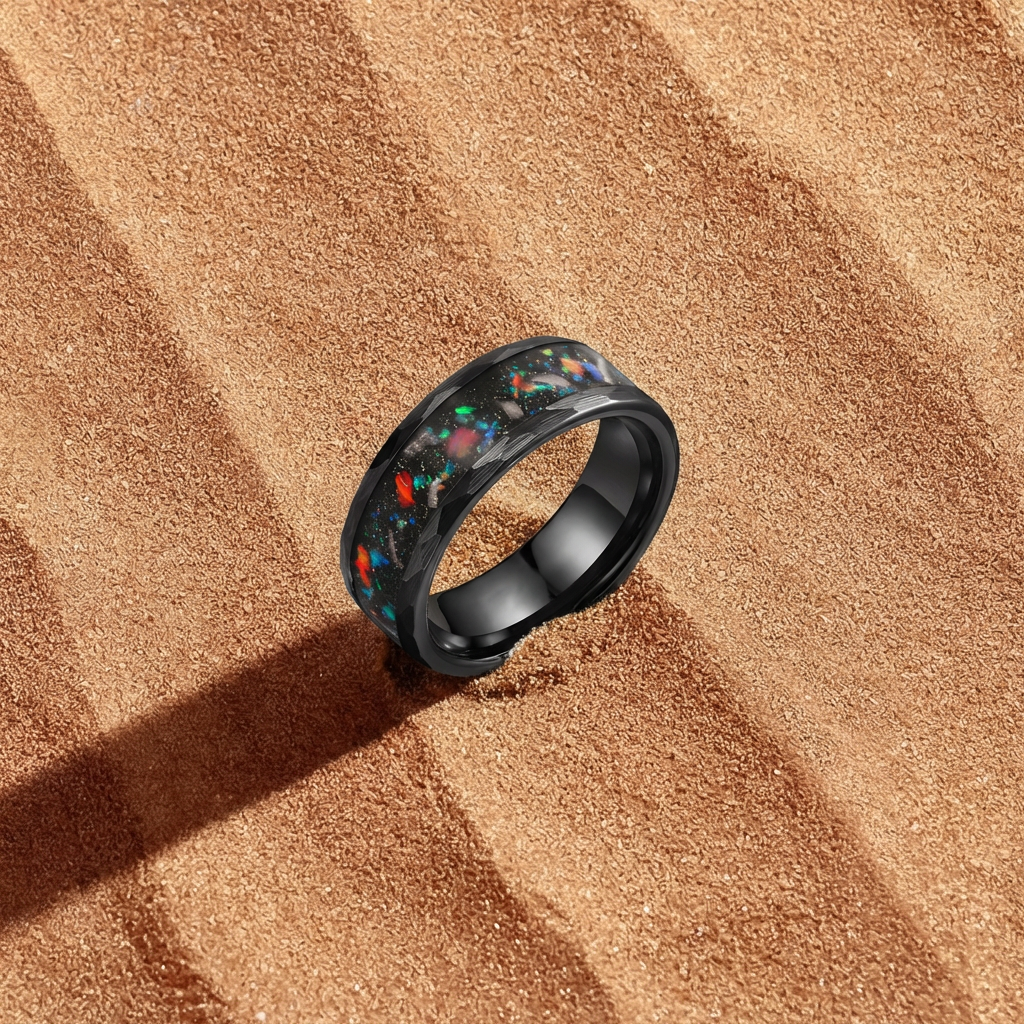
Thus began the Aethelred Rift Band. The name came later. Aethelred, from the Old English for "noble counsel." It felt right. These materials, bearing the silent wisdom of deep time, felt like the most ancient counsel of all.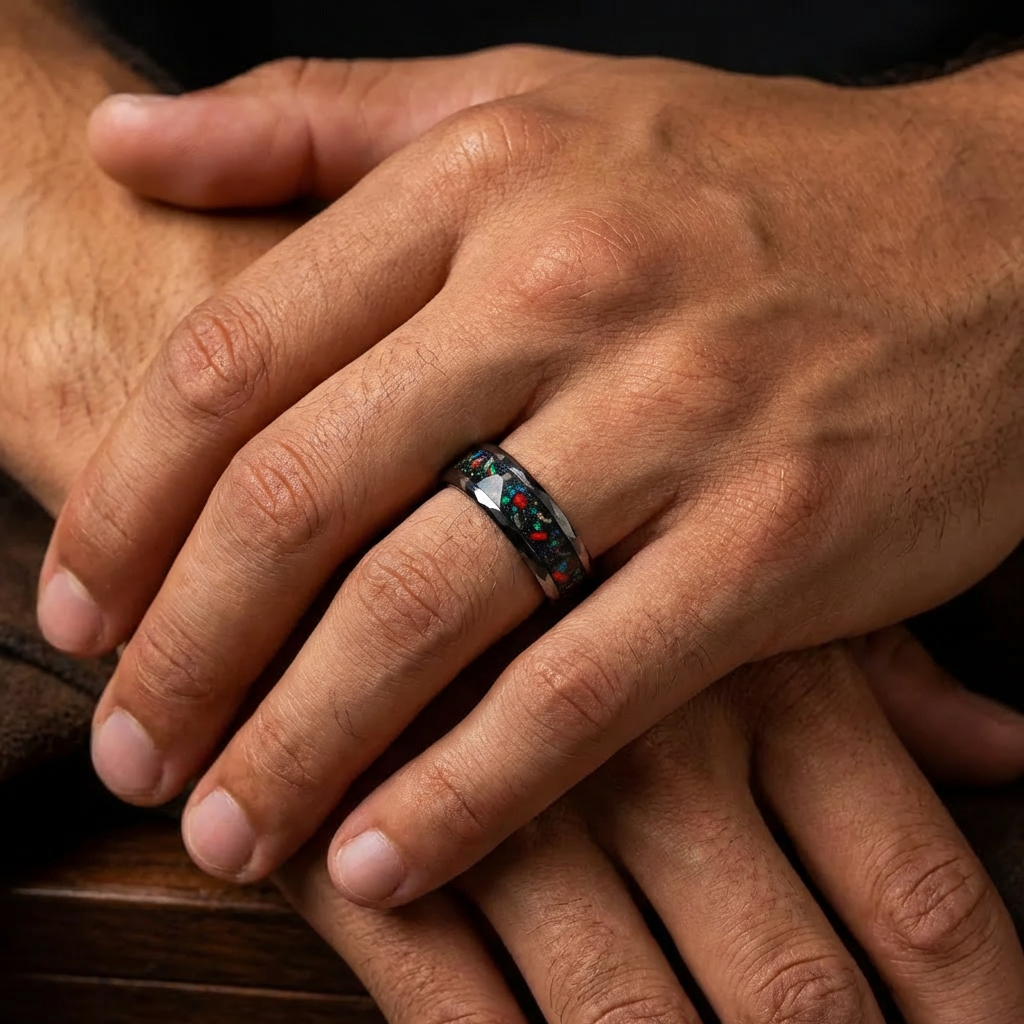
Part I: A Conversation Across Time
The concept was straightforward, even if the execution was not: to unite three materials that exist on radically different scales of time into a single object you can wear.
First: Meteorite Time.
The Gibeon iron-nickel meteorite is the anchor. Its beauty isn't applied; it's structural. Those geometric Widmanstätten lines are a fossil of its own unimaginably slow birth, cooling at a rate of about one degree every million years. They are a literal map of time.
I chose to hammer its surface. Not to stamp or press it, but to shape it with different hand hammers. When steel strikes the meteorite, the metal deforms, but the ancient crystalline structure beneath forces the fractures to follow its own primordial patterns. The finished surface holds both the fresh, textural story of my tools and the ghostly, 4.5-billion-year-old fingerprint beneath it. New marks over old bones.
Second: Opal Time.
The Galaxy Opal is time of a different kind. Its magic is optics—a precise grid of microscopic silica spheres that diffract light into that mesmerizing play-of-color. The stone I selected has a dark, nebula-like body with flashes of blue and green, and tiny mineral inclusions that, under a loupe, look like interstellar dust. That’s what makes it a "galaxy"—real cosmic clouds are never pure; they're full of debris and accident.
Third: Tungsten Time.
The black tungsten carbide is the "now." It's the strong, silent contemporary—dense, dark as a moonless night, and nearly impervious to wear. Its job is to frame and protect the other two, to tether their eternity to the human everyday. When the meteorite’s rugged history and the opal’s liquid light are cradled by this cool, severe band, a dialogue begins. It’s a conversation between permanence and flux.
Part II: Making: Between Precision and Accident
Setting the opal was the hardest part.
Opal is soft, prone to cracking, sensitive to heat and dryness. The hammered meteorite surface was deliberately uneven. A traditional prong setting would hide too much of the story. The solution was a partial bezel: a subtle lip of the tungsten band rises to gently cup the opal's waist, so from above, the stone appears to have welled up from the iron landscape itself.
The polishing took three days. Three materials, three different hardnesses, three personalities. Different papers, different pressures, until the transition from the meteorite's roughness to the opal's glow to the tungsten's slickness felt seamless under a fingertip. One pass, three sensations.
My favorite accident happened at the very end. During the final polish, the buffing wheel caught a microscopic divot in the meteorite at just the right angle. The nickel-iron crystals there reflected a single, brilliant streak of white light—like a meteor flash across a dark sky. I stopped immediately. That streak stays.
Part III: On the Hand
A friend who is an astronomer was among the first to try it on. He tilted his hand under the light. "Fascinating," he said. "The meteorite is solidified deep past. The opal is an active optical event, happening in real time. The tungsten is human-industry present. You're wearing a temporal equation."
Another friend was more direct: "It looks like it should be heavy. But it's not."
I loved that. What it carries is heavy: the memory of the solar system's birth, the quiet miracle of diffracted light, the attempt to marry them. But good design should feel effortless. It shouldn't weigh you down.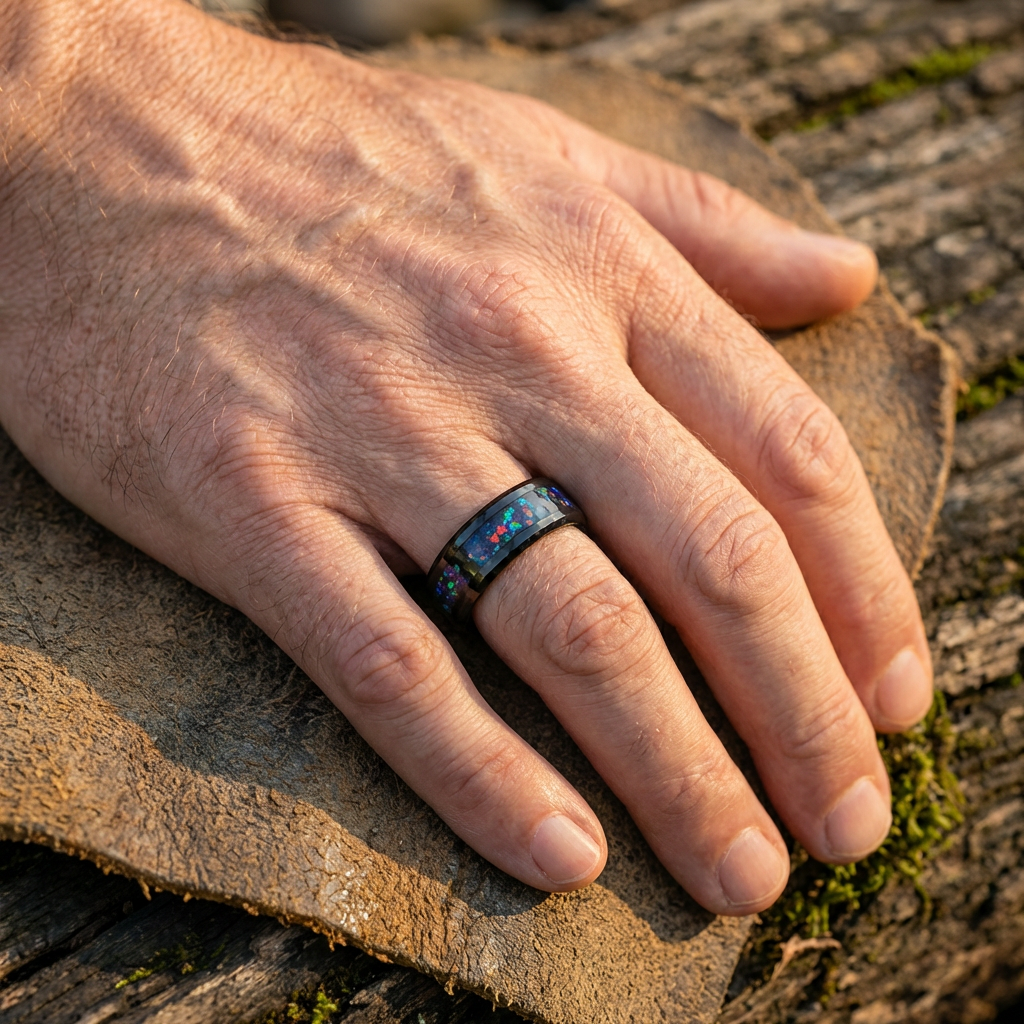
Part IV: Why 'Aethelred Rift'?
"Rift" felt obvious—a fissure, a gap. Visually, there is a rift between the dark, textured meteorite and the luminous opal. But the true rift is in scale: it's a chasm of time between the meteorite's near-eternal stasis and the opal's ever-shifting play-of-light. It's a rift of space, between the desolate asteroid belt and the watery geological conditions that formed the opal, and the now of your own living room.
"Aethelred"—that "noble counsel"—I leave for the wearer to interpret. For me, it's the silent advice whispered by these ancient materials: that the iron in this meteorite, the silica in this opal, the carbon in our own bones, all share the same stellar origin. We are, all of us, temporary arrangements of starstuff. To wear this ring is to feel that truth against your skin.
Part V: Afterwards
Now, the ring rests on a piece of indigo velvet. Under the angled lamp, the opal's deep blues begin to stir, pulsing slowly as the stone turns. The hammer marks on the meteorite cast long, intricate shadows. The tungsten band drinks the light, a dark horizon holding it all together.
I sometimes wonder where this ring will be in a hundred years. The opal may craze slightly if it dries out (so let it breathe some humidity now and then). The meteorite will gather a few more fine scars. The tungsten will likely look the same. And the people who wore it—their warmth, the stories they lived while it circled their finger—will those be remembered by the metal and stone?
Of course not.
But that's the alchemy of jewelry, isn't it? We project our meanings onto silent objects. And by wearing them, we give them a kind of life.
So this ring now waits for its wearer. For someone who might pause on a quiet afternoon, lost in the sealed nebula on their hand. For someone who needs the reminder: The iron in my blood is likely as old as this. Or simply, for someone who thinks it's beautiful.
That is more than enough.
The Aethelred Rift Band — For those who find their balance in the rift between the meteorite's eternity and the opal's fleeting fire. Each ring's pattern and play-of-color is a singular gift from the cosmos.